Super intelligence selling API is an ambitious phrase. In this guide, it describes an aspiration to coordinate better sales decisions across information, conversations, and business systems. The phrase itself provides no evidence of general intelligence, reliable autonomy, or business results. A useful evaluation begins by translating the ambition into specific tasks that a team can observe, test, and improve.
Define the capability behind the label
Ask what the system should actually do. Preparing an account brief, finding an unanswered product question, drafting a follow-up, and recommending an opportunity review are different capabilities. Each uses different evidence and creates a different consequence when it fails. A broad claim about intelligence does not replace a specification for any of them.
Describe the task with inputs, outputs, and boundaries. An account brief might use approved CRM fields and recent meeting notes, then produce a summary with references and open questions. Its success can be reviewed without giving the system permission to contact the customer. This makes the initial project useful while keeping later decisions about autonomy independent from claims about language quality.
Use an evidence ladder
Organize a pilot around increasing levels of evidence. The following ladder is a practical planning device, not a recognized certification or a guarantee. Move to a broader stage only when the previous stage reveals enough about actual behavior to support the next decision.
| Stage | Question to answer | Evidence to retain |
|---|---|---|
| Demonstration | Can the workflow produce a plausible result? | Inputs, output, and source material |
| Repeated evaluation | Does it work across representative cases? | Review criteria and observed failures |
| Assisted operation | Does it help people complete real work? | Corrections, time, and accepted outcomes |
| Bounded automation | Can a defined action run reliably? | Permissions, execution records, and recovery results |
Keep the evidence available to the people responsible for the next stage. A polished demo is most valuable when it exposes what still needs investigation.
Coordinate tasks without hiding uncertainty
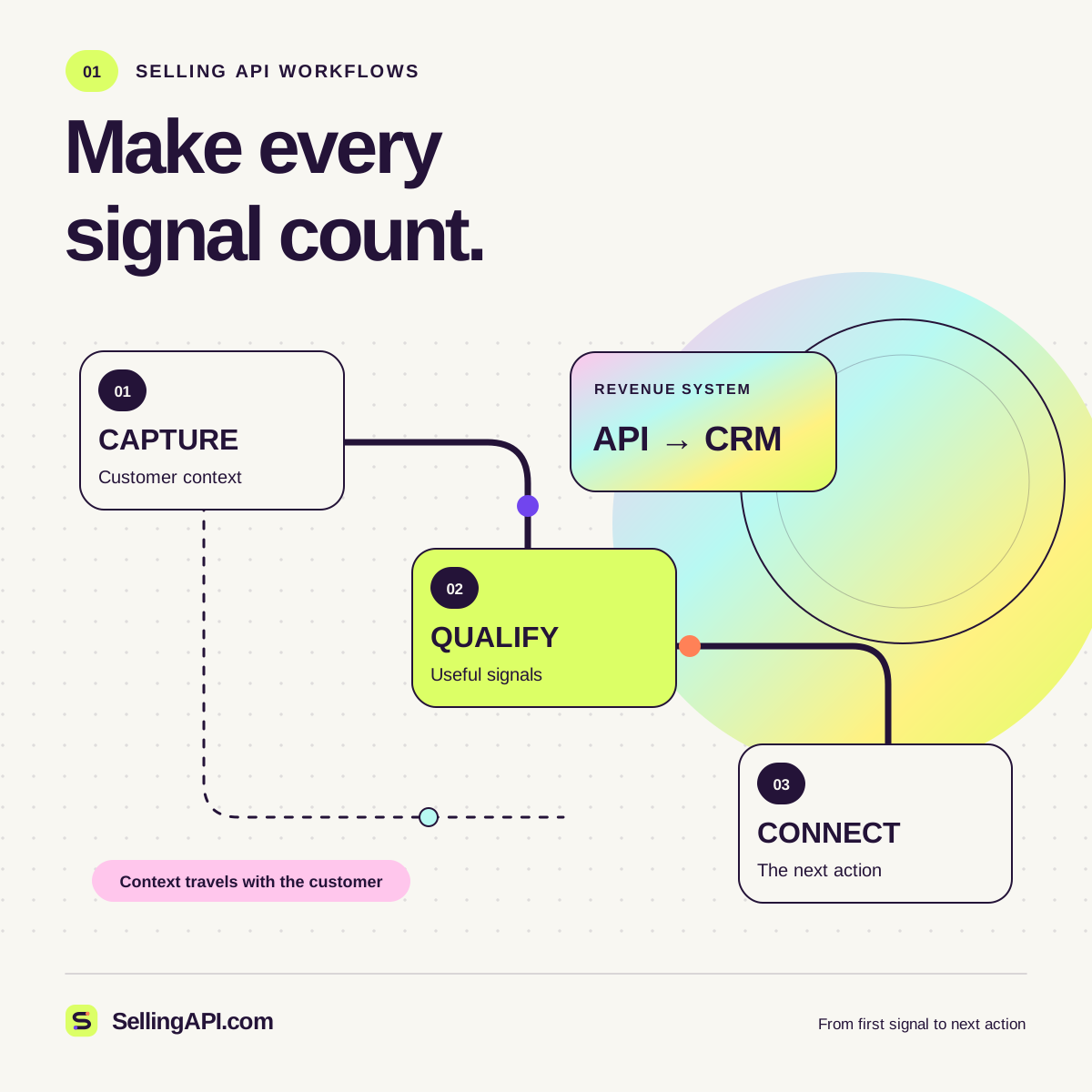
Consider an enterprise proposal workflow. One step retrieves account facts, another checks approved product references, another drafts a response, and a reviewer approves the final version. Dividing the work can make responsibilities clearer, but every handoff needs a defined result. If the research step found no support for a requirement, the writing step should retain that uncertainty.
More assistants do not automatically produce a better answer. Ask whether each additional step contributes new evidence, an independent check, or useful specialization. Remove stages that simply rewrite the same material. Keep a record of source identifiers and unresolved questions through the workflow. Otherwise a cautious initial observation can become an unsupported certainty after several rounds of fluent summarization.
Separate capability from authority
A system may be good at preparing an action while still requiring permission to execute it. Treat record access, draft creation, message delivery, pricing changes, and contract commitments as distinct capabilities. OpenAI's function calling documentation explains how applications connect model requests to their own tools. Your business rules determine which requests may proceed.
For example, a proposal assistant can identify that a buyer requested a nonstandard term, find the appropriate owner, and prepare a concise review request. That useful reasoning does not authorize the assistant to accept the term. Design a clear transition from preparation to commitment, and record who or what approved it. The same principle applies to sending communications and updating important opportunity fields.
Measure decision quality with suitable comparisons
Start with outcomes close to the work itself: unsupported statements, missing account details, reviewer corrections, and time to an acceptable result. Revenue changes can involve many influences, including the market, product, sales coverage, and which opportunities entered the pilot. A stronger revenue period alone does not establish that the assistant caused the improvement.
Use comparable tasks and a consistent review process when comparing approaches. Track which customers and cases are represented, and inspect failures that an average score might obscure. OpenAI's evaluation guidance supports task-specific measurement and human feedback. A useful operating review also asks whether the team can explain why a recommendation was appropriate and identify when the system should have requested more information.
Give the workflow an accountable owner
NIST's AI Risk Management Framework is a voluntary resource for incorporating trustworthiness into AI design, use, and evaluation. Its four core functions are Govern, Map, Measure, and Manage. A sales team can use that structure to connect technical behavior with responsibility for customer experience and business decisions.
In practical terms, name the workflow owner, describe the affected users and decisions, measure performance, and define how issues are handled. Establish who maintains product references and who can pause an automated action. Keep customer feedback and operator corrections in the improvement process. Ownership should continue after a successful pilot, because the product information, integrations, and sales process will keep changing.
Examine feedback loops in recommendations
Be careful when a recommendation changes the evidence used to judge it. Suppose a lead-ranking workflow causes sellers to contact only the highest-ranked accounts. Those accounts will accumulate more sales activity, while the others may produce little new information. A later review that treats contact volume as proof of lead quality could reinforce the original ranking without discovering whether it was useful.
For a pilot, record which opportunities the workflow influenced and which decisions people made independently. Review a deliberate sample of overlooked cases, within the team's ordinary operating rules, to understand what the system may be missing. Keep predictions separate from observed outcomes in the data model. A predicted close date should not be copied into a field that later serves as evidence of a confirmed customer timeline.
This is also a reason to preserve explanations and sources. A recommendation based on an explicit customer request is different from one based on a loose similarity to previous accounts. Reviewers need that distinction to choose an appropriate response and to investigate whether the recommendation remains sensible as conditions change.
Build a roadmap from demonstrated value
Begin with one recurring problem that sellers can describe clearly. A proposal preparation delay, incomplete meeting handoff, or inconsistent product answer offers a concrete starting point. Choose the smallest workflow that addresses it, define the evidence needed, and identify a manual recovery path. Expand when the team understands the result and can operate the process reliably.
Keep aspirational language separate from the implementation record. A roadmap can pursue increasingly capable assistance while remaining precise about what works today. The strongest sales intelligence project helps people see relevant information, ask better questions, and make accountable decisions. Its credibility comes from documented behavior and useful outcomes, with each increase in authority justified by the evidence gathered along the way.